
Heritage Science Sverige Forum 2026
Välkommen till årets nationella forum för kulturarv och vetenskap. Som deltagare kommer du att få en inblick i aktuella tvärvetenskapliga projekt och möta en bred representation av yrkesverksamma inom området.
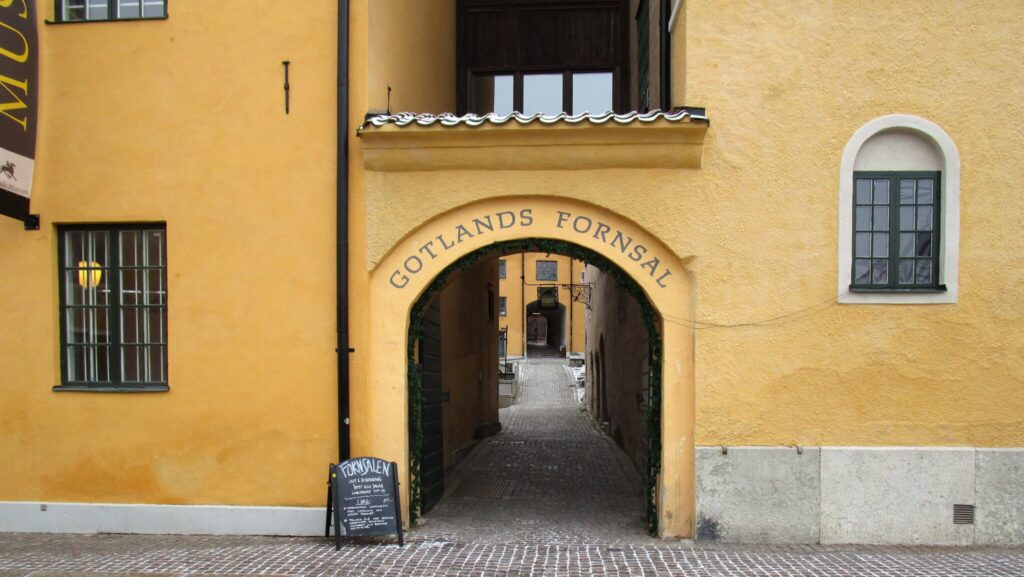
Heritage Science Sverige forum 2026, det sjunde i raden, hålls den 6–8 oktober på plats på Fornsalen, Gotlands museum, i Visby. Denna gång arrangeras forumet genom ett samarbete mellan Gotlands Museum, Uppsala universitet, Riksantikvarieämbetet samt nätverket Heritage Science Sverige. Forumet syftar till att lyfta fram heritage science i Sverige och öka dess synlighet som forskningsområde och kommer att innehålla föredrag, visningar och praktiska övningar med sikte på att främja kunskap inom olika forskningsdiscipliner.
Heritage science är ett expanderande och internationellt etablerat forskningsområde som förenar humaniora, naturvetenskap och teknik.
När: 6 oktober kl 10.00 till den 8 oktober 2026 kl. 14.45
Var: Visby.
Konferensspråk: I huvudsak engelska.
Anmälan är nu stängd
Program
Första och andra dagen hålls på Gotlands Museum. Under dag tre väljer du mellan olika workshoppar på Uppsala universitet vid Campus Gotland eller i Kulturarvslaboratoriet på Riksantikvarieämbetet. Du kan också välja att gå en guidad stadstur i Visby. Läs mer under dag 3.
Dag 1 | Tisdag 6 oktober 2026, kl. 10.00–17.00
Plats: Gotlands museum, Strandatan 14, Visby, till karta (openstreetmap.org)
10.00 | Registreringen öppnar
10.30-11.30 | Heritage science på Gotlands Museum: Guidad visning
Guidad visning på Gotlands Museum.
11.30–12.30 | Lunch
Serveras i Sävesalen, på Gotlands Museum.
13.00 | Välkomna – årets forum öppnar
Johanna Pietikäinen Kidvall, avdelningschef för Samlingar och arkeologi på Gotlands Museum och Jenny Helin, rektorsråd för Uppsala Universitet, Campus Gotland, öppnar årets forum och hälsar alla deltagare välkomna.
13.10 | Session 1: All things Gotland
Keynote speaker
From the earliest cancer to medieval death: X-ray tomography at the interface between archaeological and forensic science.
Patrick Randolph-Quinney, Associate Professor, Department of Archaeology, Ancient History and Conservation, Uppsala University.
Presentations
Reading runes hidden for a millennium. Helena Berg, Magnus Källström, Donglei Chen, Anna Fedrigo, Per Ahlberg, and Sven Kalmring
Runic inscriptions in Gotlandic churches. Laila Kitzler Åhfeldt, Michael Fergusson and Per Widerström
Bulverket – Heritage science under water – how combinations of interdisciplinary approaches helps solving broad scientific problems. Peter d’Agnan
Heritage in the Cloud – Beyond the Digital Body toward the Spirit of Place in Gotland. Zahra Mohamadi, Mattias Legnér, Patrick Randolph-Quinney and Eliel Camargo-Molina
Fika – Coffee break
Serveras i anslutning till Sävesalen, på Gotlands Museum.
15.15 | Session 2: Safekeeping museums, (digital) collections and people
Keynote speaker
Aligning heritage science with institutional priorities – reflections and work in progress.
Carl Heron, Head of Scientific Research at the British Museum, Honorary Professor, Institute of Archaeology, UCL University College London.
Presentations
Museums and Open science. Elin Fornander, Anna Arnberg, Babs Bornsäter, Marei Hacke and Anna Silwerulv
GRIDH, University of Gothenburg DIGICURE – Digital cultural resilience and protection. Jonathan Westin, Gunnar Almevik, Daniel Brodén and Cecilia Lindhé
Clean Air, Preserved Heritage – Tackling Airborne Pesticides in Museums. Peter Mc Elhinney, Ann Sjöblom and Marta Segura Roux
Lightning talks
Documentation of damages from use on red and white chasubles in silk 1930-1960. Heidi Åberg Bertelsen
Shooting the ”shooting painting”. My Bundgaad, Silvia Russo, Silvia Bottura- Scardina and Kaj Thuresson
Paus – Break
18.00 | Middagsmingel
Mingel för middagsgäster på Gotlands Museum.
Per Widerström, arkeolog på Gotlands Museum introducerar bildstenarna.
18.30 | Konferensmiddag
Vi avslutar dagen med middag i bildstenshallen på Gotlands Museum.
Dag 2 | Onsdag 7 oktober 2026, kl. 08.30–17.00
Välkomna till dag 2
Plats: Gotlands museum, Strandatan 14, Visby, till karta (openstreetmap.org)
08.30 | Session 3: Iron Age to the Vikings
Keynote speaker
Crisis, conflict and climate – societal change in Scandinavia 300–700 CE.
Kerstin Lidén, Professor, Department of Archaeology and Classical Studies, Stockholm University.
Presentations
Determining the Baltic provenance of Chinese amber artefacts in the Iron Age using FTIR spectroscopy. Yunyun Yang, Marei Hacke, Elyse Canosa and Helena Berg
Boat graves WIVA (World in the Viking Age). John Ljungkvist and Kaj Thuresson
Fika – Coffee break
Serveras i anslutning till Sävesalen, på Gotlands Museum.
10.15 | Session 4: Intentions and interventions
Keynote speaker
POLYCHROME – Early Fieldwork Results.
Noëlle L. W. Streeton, Professor – Conservation, Department of Archaeology, Conservation and History, University of Oslo
Presentations
The Enactment of the Authentic Original: Conservation-restoration of kalkmålningar in Swedish churches around 1850–1980. Hélène Svahn Garreau
Defining Good Repair through Higher Education. Riina Sirén & Iida Kalakoski
Traces of Environment and Humans: Interdisciplinary Studies of Dirt on Historical Textiles. Anders Blom, Sebastian Karlsson, Johanna Nilsson, Jan Pettersson and Karin Tetteris
Lunch
Serveras i Sävesalen, på Gotlands Museum.
12.50 | Session 5: Diving deep into materials and methods
Keynote speaker
Innovation and Evolution of Copper-Based Metalworking in the Sasanian and Early Islamic Periods on the Iranian Plateau: A Multianalytical Approach.
Omid Oudbashi, Senior Lecturer in Conservation, Conservation Scientist, Researcher at the Center for Critical Heritage Studies (CCHS), University of Gothenburg.
Presentations
Spectral Unmixing of Paintings Using μXRF Mapping and Multivariate Methods. Sebastian Karlsson and Jan Pettersson
Water-ethanol injection grouts for the stabilisation of salt-loaded delaminated plasters: Investigation on phases formation and grouts physico-mechanical properties. Chiara Pasian
Corrosion analysis by visual examination – can you trust your eyes? Ida Langemark
Lightning talks
Bound to Fail? Cold Paints and Their stability in Historic Stained Glass. Teresia Strömgren, Louise Wilson, Silvia Bottura-Scardina and Kaj Thuresson
Paraloid B72 Applied to Wall Paintings: a Preliminary Investigation on its Physical Stability in Hot Climates. Teal Patterson and Chiara Pasian
Fika – Coffee break
Serveras i anslutning till Sävesalen, på Gotlands Museum.
14.50 | Session 6: Continuation: Diving deep into materials and methods
Presentations
Kuh-e Khwaja Wall Paintings Revisited: Scientific Analysis of Rare Surviving Fragments in the Metropolitan Museum of Art. Atefeh Shekofteh
Tracing the Medieval Palette: Non-Invasive Insights into Swedish Manuscript Fragments. Thea Winther
Near Infrared Hyperspectral Imaging, some archaeological and heritage applications. Johan Linderholm
Archaeology in rewetted peatlands: current state of knowledge on in-situ preservation. Marei Hacke
Lightning talks
Cultural heritage buildings network at RISE. Björn Schouenborg
From Characterization to Application: Testing Methods Supporting Historic Mortar Reproduction. Natalia Dedousi
Break
16.20 | Panel discussion
17.00 | End of day 2
Dag 3 | Torsdag 8 oktober 2026, kl. 09.00–14.45
Välkomna till dag 3
Här väljer du mellan olika workshoppar på Uppsala universitet vid Campus Gotland eller i Kulturarvslaboratoriet på Riksantikvarieämbetet, då ingår fika. Det är också möjligt att istället för workshop välja en guidad stadstur i Visby. Under denna dag intas lunch på egen hand.
Plats: Se adress och karta för respektive val.
09.00 – 14.45 | Workshoppar eller guidad stadstur
Samling inne vid entrén på respektive plats klockan 09.00:
- Uppsala Universitet, Campus Gotland, Cramérgatan 3, till karta (openstreetmap.org)
- Riksantikvarieämbetets kulturarvslaboratorium, Artillerigatan 33 A, till karta (openstreetmap.org)
- Gotlands museum, Strandgatan 14, till karta (openstreetmap.org)
09.00 – 10.30 | Guidad stadstur i Visby: Bakom låsta dörrar
Följ med på guidad stadstur i Visby ”Bakom låsta dörrar”. Samling i entrén på Gotlands Museum, max. 30 personer. Bekväma skor rekommenderas.
09.00 | Workshoppar på Uppsala Universitet, Campus Gotland
- 3D modelling and reconstruction methods in cultural heritage (Patrick Randolph-Quinney) Max. 20 persons.
This workshop will cover the theoretical and practical application of 3D capture and modelling techniques applied to cultural heritage. Participants will be introduced to surface and volume modalities such as micro-computed tomography, photogrammetry (SfM), structured light scanning (SLS), and LIDAR/Laser scanning. Participants will have the opportunity to develop practical skills in SLS and SfM from object capture through to the production of geometrically accurate and photorealistic models. The ethical implications of digital heritage modelling will also be explored.
09.00 | Workshoppar på Riksantikvarieämbetet, kulturarvslaboratoriet
- Lime mortars and mechanical testing (Magnus Wessberg, Uppsala University, Malin Ek, Målarkalk AB) Max. 8 persons.
Mechanical testing is used to evaluate how materials respond to applied forces and is an important tool in both materials research and quality control. By subjecting a material to controlled loading, properties such as strength, stiffness, and durability can be determined. For masonry materials, including mortars, compression testing is one of the most commonly used methods because these materials are primarily designed to withstand compressive loads.Lime mortars have been used in construction for centuries and remain essential in the conservation of historic buildings. Their mechanical properties differ significantly from those of modern cement-based materials, making proper characterization particularly important. Compression testing provides a measure of a mortar’s compressive strength, allowing different mortar formulations, curing conditions, and material compositions to be compared.Within the field of heritage conservation, compression testing is not only used to assess strength but also to ensure compatibility between repair mortars and historic masonry. Understanding the mechanical behaviour of lime mortars is therefore an important step in selecting appropriate materials and developing durable conservation strategies. This workshop introduces the principles of mechanical testing and provides hands-on experience with the compression testing of lime mortar specimens. - Introduction to electron microscopy for cultural heritage (Elyse Canosa, Swedish National Heritage Board) Max. 7 persons.
Electron microscopy is a powerful tool in cultural heritage studies for both observing details and understanding elemental composition on the micro and nano level. Using electron microscopes can be intimidating and many questions arise when working with them, such as: is it ok to put my sample in an electron microscope? How should I prepare my sample? And what do I do to obtain good quality images and elemental information? This workshop in the Heritage Laboratory at the Swedish National Heritage Board will help to answer these questions by introducing both theory and practical elements of electron microscopy. The workshop is aimed at people who have limited or no experience with electron microscopy but are curious about learning more. Participants are welcome to bring their own samples, but we cannot guarantee that we will be able to use them for the practical sessions. - MA‑XRF for elemental imaging in heritage science (Silvia Bottura Scardina, Swedish National Heritage Board) Max. 10 persons.
Elemental chemical imaging has emerged as a valuable component in heritage science research, with macro X-ray fluorescence, MA-XRF, now widely recognised for its capacity to deliver spatially resolved information through non-invasive analysis. Because MA‑XRF requires no sample preparation and is fully deployable within heritage environments, it provides fast, flexible insights into both elemental compositions and distribution. These data can support studies of heritage technology, chronology, and, in some cases, the provenance of heritage items.This HSS Forum workshop introduces the fundamentals of MA‑XRF through a focused presentation and a live practical demonstration. Participants will gain an understanding of how MA‑XRF can be integrated into analytical workflows, and how it complements existing analytical approaches within the broader heritage community. The session is designed to support both newcomers and experienced practitioners interested in expanding their methodological toolkit. Participants are welcome to bring small objects for live MA‑XRF analysis. - Preventive preservation workshop with a focus on Oddy testing (Silvia Russo, Swedish National Heritage Board) Max. 12 persons.
Do you work with the storage, display, transport, or packaging of collection objects? Are you interested in understanding how the materials used for these activities might affect collection objects? Then the Oddy test might be a useful tool for you!The Oddy test can help to indicate if a material emits pollutants that can be harmful to cultural heritage collections. Materials of interest are often those used for display, storage, transport, or packing. Join the Heritage Laboratory at the Swedish National Heritage Board to learn about the Oddy test, gain some practical tips, and figure out if you can perform Oddy tests at your own institution. - Museer och öppen vetenskap – How can I FAIR-ify and share my heritage science data? (Babs Bornsäter, Uppsala universitetsbibliotek, Anna Silwerulv, Statens museer för maritim-, transport- och försvarshistoria och Elin Fornander, Statens historiska museer.) Max. 12 persons.
This workshop provides practical tools and guidance on how to make your heritage science data FAIR and how to share them openly and responsibly. We will present concrete examples of how to work with your dataset, add suitable metadata, and publish your data so that they are openly accessible. You will become familiar with concepts like open licenses, READMEs, appropriate file formats, controlled vocabularies, and data publishing platforms/repositories. The session includes ample time for questions, whether they are specific to how you want to share a particular dataset or more general about FAIR data and open datasets. No background knowledge is needed; bring your laptop if you want to try things hands-on or bring your own dataset, or simply join in.
Om nätverket och tidigare forum
Konferensen Heritage Science Sverige forum 2026 organiseras av Gotlands Museum, Uppsala universitet, Riksantikvarieämbetet samt nätverket Heritage Science Sverige.
Projektgruppen består av Johanna Pietikäinen och Lisa Berg från Gotlands Museum, Pat Randolph-Quinney och Magnus Wessberg från Uppsala universitet, Omid Oudbashi från Göteborgs universitet, Marei Hacke, Sara Norrehed och Ilse Vuijsters Hammarström från Riksantikvarieämbetet.
Läs gärna publikationerna från tidigare forum och om nätverket för Heritage Science Sverige.