
Risk assessment and high-risk objects
Even with unlimited resources, it is not always possible to establish an unbroken chain of documented ownership of an object. Gaps in provenance may be due to previous owners failing to keep documentation, documentation being lost, or auction houses avoiding revealing the identities of buyers and sellers for reasons of privacy.
A risk-based approach can be applied when assessing the appropriate level of due diligence in a specific case. This helps the organisation to allocate time and resources to areas where they will have the greatest impact.
A number of groups of objects that should attract particular attention in connection with acquisitions or loans are described below:
- archaeological objects found outside Sweden,
- archaeological objects found in Sweden,
- objects from Syria and Iraq,
- ecclesiastical furnishings and other sacred objects,
- religious or ceremonial objects,
- objects that may have been Nazi-confiscated, and
- objects consisting of endangered plants or animals.
Archaeological objects found outside Sweden
Illegal excavation and looting of archaeological sites, both on land and underwater, is a widespread global problem that attracts a great deal of attention. Although this type of crime occurs in many parts of the world, some countries and regions are especially vulnerable, particularly those affected by war or armed conflict. The ever-increasing demand for antiquities and the fact that older cultural objects are a limited and unique resource provide strong incentives for smuggling and looting of archaeological sites and shipwrecks. This is why archaeological objects found outside Sweden are classified as high-risk objects.
Studies have shown that looted objects from conflict zones are often ‘put on ice’ for an extended period of time, which means they are placed on the market only when the conflict is no longer present in the public consciousness. Signs that something has recently been taken out of the ground, such as traces of soil, can easily be removed when time is on the looter’s side.
Archaeological objects that have been excavated illegally have no physical owner who can report the object stolen or missing. As objects first have to be discovered, or found, in order to reach the market, the legitimacy of the circumstances surrounding their discovery needs to be checked against the national laws in the country of origin.
The following questions should be asked when considering the acquisition or loan of archaeological objects or objects believed to be parts of historical monuments.
- Does the object come from an area affected by war, conflict or extensive looting of cultural heritage?
The protection of cultural heritage is often weak or non-existent in such areas, and the existence of an active illegal market increases the risk of the object having been illegally excavated or exported or having an unethical background. - Does the object appear in any of the ICOM Red Lists?
The ICOM Red Lists identify cultural objects from particularly vulnerable regions. Inclusion in these lists indicates a high risk and requires meticulous scrutiny. - Does the legislation of the country of origin prohibit the export or sale of archaeological objects?
Is there documentation that proves lawful export? Many countries have laws that regulate or prohibit the export of archaeological objects. Checking this is crucial so as not to breach national legislation.
If legal provenance cannot be established, the object should be regarded as a high-risk object: this requires further checks and consultation with experts in the field. If there is any uncertainty following consultation, the object should not be acquired.
Archaeological objects found in Sweden
Archaeological finds discovered in Sweden are covered by the provisions of Chapter 2 of the Swedish Historic Environment Act (1988:950). This Act defines prehistoric finds as ownerless objects discovered in connection with ancient sites or found under other circumstances and which can be presumed to date back to before 1850. There are two types of prehistoric finds:
- The first type is finds that belong to the State, which includes all finds from archaeological investigations and finds found at or near ancient sites.
- The second type is finds that belong to the finder, if they are found in circumstances other than at an ancient site. However, if these finds contain gold, silver, bronze or copper, they have to be offered to the State under the rules of preemption. This also applies to hoards; that is, several objects that are presumed to have been buried together.
Breaking the rules that protect ancient sites and prehistoric finds may constitute an antiquities offence. It is unlawful to damage, conceal or sell objects that by law should belong to or be offered to the State.
Trading in prehistoric finds can be complex, particularly as finds have often been unknown to the authorities for a long time. This makes it difficult to determine whether trade in a specific object is lawful. The history of the find and the circumstances of its discovery must be scrutinised with care in the event of acquisition or loan. Although offences against the Swedish Historic Environment Act may be time-barred and the requirement for the right of pre-emption may lapse, it is important from an ethical standpoint to refrain from trading in finds whose background is uncertain.
The following questions should be asked when considering the acquisition or loan of archaeological objects found in Sweden.
- Is the object a prehistoric find under the Swedish Historic Environment Act, or could it be presumed to be?
This question helps to determine whether the object is subject to specific rules and obligations, such as the right of pre-emption or State ownership. - Is there any documentation or information available on the circumstances of the discovery of the find and the location where it was found in order to ensure that possessing or trading in the object is lawful?
This question is intended to clarify the provenance of the find and check whether it breaches the rules for prehistoric finds in the Swedish Historic Environment Act. - Has the object been previously examined by authorities or museums, or has the State asserted a claim to it?
This clarifies whether the object has been legally reported or assessed and reduces the risk of handling illegally acquired objects. Any object that is subject to the the right of pre-emption requires a rejection from the Swedish National Heritage Board in order to accrue to the finder and thus be acquired by a party other than the State.
If legal provenance cannot be established, the object should be regarded as a high-risk object: this requires further checks and consultation with experts in the field. If there is any uncertainty following consultation, the object should not be acquired.
Objects from Syria and Iraq
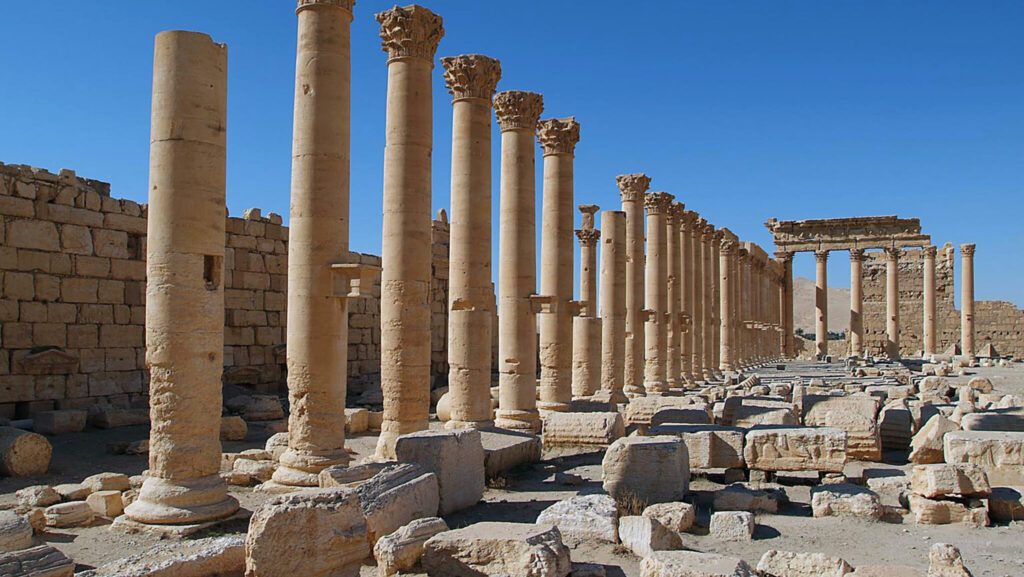
Historic monuments, including several World Heritage sites, have been destroyed and looted during the wars in Syria and Iraq. The UN Security Council has adopted two resolutions with a view to condemning the destruction of cultural heritage in these countries and preventing the financing of terrorism. Against this background, the EU has introduced import and trade restrictions that are directly applicable in Sweden. In Sweden, anyone violating the EU regulations can be convicted of an offence under the Act on Certain International Sanctions (1996:65).
The following is applicable for cultural objects:
Iraq: Ban on the import of, export of and trade in Iraqi cultural property and other objects of archaeological, historical, cultural, rare scientific and religious value that have been illegally exported from Iraq since 6 August 1990. (Council Regulation (EC) No 1210/2003, Article 3).
Syria: Ban on the import, export and brokering of Syrian cultural property and other objects of archaeological, historical, cultural, scientific or religious significance from Syria, if there are reasonable grounds to suspect that the objects were illegally exported from the country without the owner’s consent after 9 May 2011 (Council Regulation (EU) No 1332/2013, Article 11c).
The following questions should be asked when considering the acquisition or loan of objects that may be presumed to have originated in Syria or Iraq:
- Does the object appear in any of the ICOM Red Lists for Syria or Iraq?
The ICOM Red Lists identify cultural objects that are particularly vulnerable to illegal trade.
- Can it be proven that the object was not exported from Syria or Iraq after the relevant dates?
As there is a ban on importing or trading objects illegally exported after 6 August 1990 (Iraq) or 9 May 2011 (Syria), there must be documentation (e.g. export licence or evidence) to prove the provenance of the object.
- Are there credible sources that can confirm the origin of the object?
As it is often difficult to determine the country of origin of an object, it is particularly important to investigate, with the aid of credible sources, whether an object comes from Syria or Iraq so as to avoid breaching EU restrictions and the risk of dealing in stolen objects.
If legal provenance cannot be established, the object should be regarded as a high-risk object: this requires further checks and consultation with experts in the field. If there is any uncertainty following consultation, the object should not be acquired.
Ecclesiastical furnishings and sacred objects
Ecclesiastical furnishings and sacred objects refer mainly to older objects, usually made of metal, textile or wood, which are being or have been used for worship purposes or for decoration in ecclesiastical settings. Only a very limited number of such objects are legal on the market. At the same time, thefts of cultural objects from Swedish churches are a recurring problem. In some cases, such objects have been traced when they have were offered for sale at international auction houses with online marketing.
According to Chapter 4 of the Swedish Historic Environment Act, furnishings of a cultural and historical value that belong to a church building or other ecclesiastical building, church plot or burial ground shall be properly stored and conserved. Each parish must maintain an inventory of all objects of cultural and historical value. Permission from the County Administrative Board is required if a parish wishes to dispose of an object included in the list, for any reason. If no such permission is obtained from the County Administrative Board, the object may – in exceptional cases – nevertheless have been lawfully removed from its original context. Parishes belonging to free church associations, for example, are permitted to dispose of and sell furnishings without the permission of the County Administrative Board.
Church objects were also disposed of, to some extent, during the Reformation, for example, or in connection with the intensive building of churches in the 19th century. During this period, smaller medieval churches were often demolished or deconsecrated, and some of their furnishings were not incorporated into the collections of the new churches. There were also privately owned churches and chapels in some parts of the country, particularly during the Middle Ages and among the aristocracy, from which associated furnishings could be disposed of over time.
Burglaries and theft of cultural objects from religious buildings are a widespread global problem. Both historic cultural objects and sacred objects are stolen and sold on, often in other countries. This problem is particularly severe in areas affected by armed conflict, such as Ukraine, but it also occurs in peaceful regions. The legal protection of cultural objects originating in sacred settings, as well as the extent to which objects of this kind may be lawfully traded on the market, varies from state to state.
The following questions should be asked when considering the acquisition or loan of ecclesiastical furnishings or sacred objects.
- For Swedish objects: Has the County Administrative Board issued a permit showing that the object has been lawfully removed from a parish inventory? Or is there another legitimate explanation as to why the object is on the market?
- For objects of foreign provenance: What is stated in the legislation of the country of origin regarding the export and sale of sacred objects? Does the object appear in any of the ICOM Red Lists?
- General: Is the object recorded in any database of stolen cultural objects?
Religious or ceremonial objects
Religious and ceremonial objects are items used in religious or spiritual rituals and hold great cultural and symbolic significance. According to the ICOM Code of Ethics, special consideration must be given when acquiring culturally sensitive material, particularly objects of religious significance. Such objects should only be acquired if they can be stored safely and handled with respect. This must be done in accordance with the standards of the museum sector and with regard to the interests and beliefs of members of the community or the ethnic or religious groups with which the objects are associated.
The United Nations Declaration on the Rights of Indigenous Peoples emphasises the right of indigenous peoples to practice, protect and develop their cultural traditions and expressions.
This includes archaeological and historical sites, objects and other forms of cultural heritage. Article 11 emphasises their right to preserve and develop both tangible and intangible cultural expressions, while Article 12 specifically addresses their right to use and control ceremonial objects and to have their human remains returned.
It is essential to engage in dialogue and cooperate with the community or group with which the object in question is associated. Cultural heritage institutions wishing to discuss issues relating to the handling of Sami cultural heritage can consult the Sameting, the Sami Parliament, which is an expert authority on Sami issues.
The following questions should be asked when considering the acquisition or loan of culturally sensitive material, particularly objects of religious or ceremonial significance.
- Has there been consultation with the community, ethnic group or religious community with which the object is associated, and is the acquisition compatible with their interests, norms and beliefs?
- Is any documentation available showing that the object was acquired and transferred in accordance with national and international laws? Including the United Nations Declaration on the Rights of Indigenous Peoples.
- Can the acquirer ensure that the object will be stored and handled in a respectful and secure manner that is consistent with ethical guidelines and any requirements defined by the community or group with which the object is associated?
It is important to ensure that discussions are held with representatives from relevant parts of the community concerned, as there may be different views within the same religious or ethnic community on how cultural objects should be handled and preserved by cultural institutions.
Objects that may have been Nazi-confiscated
Between 1933 and 1945, the Nazis looted vast amounts of art, antiquities, books and other cultural objects in Germany and the occupied countries. The looting included everything from the confiscation of public and private collections to sales under threat and extortion, particularly targeting Jewish people and other persecuted groups. This organised and systematic theft took place on a huge scale. The trade in stolen objects continued after the war, and many items have still not been returned to their rightful owners. It has been estimated that around 650,000 works of art were stolen, of which around 100,000 are still missing; in addition to millions of other cultural objects such as books and religious artefacts.
At the Washington Conference in 1998, 44 states – including Sweden – agreed on principles for identifying and returning Nazi-looted objects to their rightful owners. These Washington Principles, as they are known, call for the identification and public disclosure of confiscated art, as well as fair solutions for restitution, even if the heirs of the owners cannot be traced. The 2009 Terezin Declaration, signed by 47 states, emphasises the importance of continued provenance research and transparency in the reporting of results.
Particular attention is necessary for objects created before 8 May 1945 and which may have been present in continental Europe during the war years. The following questions may assist in the assessment:
- Are there any gaps in the provenance of the object between 1933 and 1945?
- Could the object have been considered valuable by the Nazis, or could it have attracted their interest for other reasons?
- Is the object recorded in any database of confiscated or missing cultural objects from the Nazi era?
Lists of individuals and companies involved in the trade of Nazi-confiscated objects can also be used to assist in this process.
Objects consisting of endangered plants or animals
Many wildlife and plant species are threatened by extinction. The international community has decided to restrict trade in order to protect endangered species and safeguard biodiversity. This agreement is known as CITES (Convention on International Trade in Endangered Species of Wild Fauna and Flora). CITES was ratified by Sweden in 1974 and entered into force in 1975. Today, more than 180 countries have ratified the Convention. The regulations cover both live plants and animals listed under CITES, as well as parts and products made from these animals and plants.
Trade in the most endangered species is banned in Sweden and the EU. However, in some cases it is possible to obtain an exemption from the ban by applying for a CITES certificate. CITES permits are required in most cases for the import or export of endangered species between Sweden and countries outside the EU.
Common types of objects that require permits or certificates include objects such as ivory, hunting trophies, stuffed birds, eggs, feathers and furs. It is also important to verify origin and material for souvenirs made from any of these. Some objects are covered by what is known as the antiques derogation. This applies to certain objects that were worked before 3 March 1947. There is no need to apply for a certificate/permit for the trade if it is possible to clearly prove that the object is covered by the derogation.
There are a number of CITES lists that indicate the extent to which species are protected and whether a certificate/permit is needed to purchase or loan objects, and if so when.
- Appendix A species are endangered due to trade and therefore are most in need of protection.
- Appendix B species risk becoming endangered unless trade is controlled.
- Appendix C species are endangered in a specific country.
- Appendix D species are imported into the EU in such large numbers that trade controls are needed.
The Swedish Board of Agriculture is the administrative authority for CITES in Sweden and provides information on its website about the applicable rules, how to apply for certificates/permits, forms, etc.